Idaho local data guide
What Happens if an Investor Takes Constructive Receipt During a 1031 Exchange?
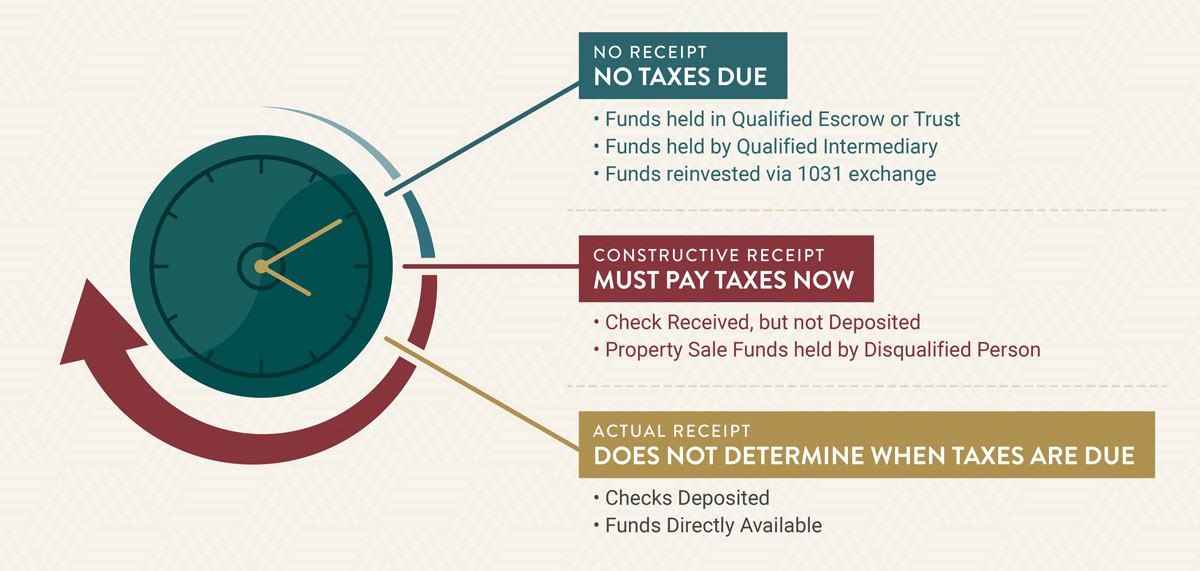
Taking actual or constructive receipt of exchange proceeds during a 1031 exchange disqualifies the transaction. This invalidation immediately triggers capital gains tax liability, nullifying the intended tax-deferred benefits of the exchange.
Updated with grounded research as of 2026-09-23.
The short answer
If the IRS determines that an investor has taken constructive receipt of proceeds from the sale of their relinquished property, the 1031 exchange is immediately disqualified. This disqualification forces the investor to recognize the full capital gains on the transaction as taxable income for that tax year, effectively ending the tax-deferral strategy.
Key facts
- Tax Consequence
- Disqualification of the 1031 exchange results in the immediate realization and taxation of all capital gains from the sale.
- Definition of Constructive Receipt
- This occurs when funds are credited to, set apart for, or otherwise made available to a taxpayer so they may draw upon them at any time, even without physical possession.
- Prevention Strategy
- Investors must utilize a Qualified Intermediary (QI) to hold all exchange funds throughout the entire 180-day exchange period to avoid direct or indirect control.
The Mechanism of Disqualification
Section 1031 of the Internal Revenue Code is strictly enforced. The core requirement is that the taxpayer must never have 'actual or constructive receipt' of the cash proceeds from the sale of the relinquished property.
Constructive receipt is a legal standard, not just a physical one. If the funds are available for your use—even if they remain in an escrow account or a bank account you control—the IRS may view this as a taxable event. This standard exists to ensure that the exchange is a swap of property-for-property rather than a disguised sale.
The Role of the Qualified Intermediary
To satisfy the IRS requirements, the proceeds from your sale must be held by a neutral third party known as a Qualified Intermediary (QI). The QI holds the funds in a secure account and uses them only to purchase the replacement property on your behalf.
You must sign a written agreement with the QI before the relinquished property closes. This agreement restricts your ability to access or pledge the funds until the exchange is complete or the exchange period expires.
Avoiding Indirect Control
It is not enough to simply avoid touching the cash; you must also avoid exercising 'control' over the funds. This includes using the funds as collateral for a loan or having the ability to direct the disposition of the funds outside of the exchange agreement.
Idaho investors should be aware that even common practices, like using proceeds to pay off unrelated debts or moving funds into personal accounts before acquiring the replacement property, constitute constructive receipt. Always route all transactional steps through your assigned Qualified Intermediary.
Common questions
Can I hold the funds in a separate business account while I look for a property?
No. Holding the funds in any account that you control, even a separate business account, constitutes constructive receipt. All proceeds must be held by a Qualified Intermediary.
What if I accidentally touch the funds?
Once constructive receipt occurs, the 1031 exchange is generally considered invalidated immediately. You should consult a tax professional or your Qualified Intermediary to discuss the potential for reporting the sale as a taxable event.
Related Idaho questions
- What is the role of a Qualified Intermediary in a 1031 exchange?
- How does the 180-day exchange period work?
- What are the consequences of missing 1031 exchange deadlines?
Sources and verification
- IRS Guidelines on Sales and Exchanges (irs.gov)
- Understanding 1031 Exchange Nuances via CLA Connect (claconnect.com)
- Learn more about What Happens if an Investor Takes Constructive Receipt During a 1031 Exchange from accruit.com (accruit.com)
- Learn more about What Happens if an Investor Takes Constructive Receipt During a 1031 Exchange from oldrepublicexchange.com (oldrepublicexchange.com)
- Learn more about What Happens if an Investor Takes Constructive Receipt During a 1031 Exchange from exchangeright.com (exchangeright.com)
- Learn more about What Happens if an Investor Takes Constructive Receipt During a 1031 Exchange from 1031gateway.com (1031gateway.com)